THE LATERALIZATION OF LT. CMDR. ALAN BEAN
by Vidal Palacios for Red Blue Shift Magazine
Imagine this: You are being shaken violently by 7.5 million pounds of thrust pushing out of five F1 rocket engines somewhere behind you, and thirty six and a half seconds after lifting off from the Kennedy Space Center atop a Saturn V, every warning indicator on your control panel simultaneously lights up, fuel-cell disconnect flags pop, and your instrumentation malfunctions.
Seventeen and a half seconds later, the “8-ball” attitude indicator begins spinning wildly, the telemetry stream from Mission Control is garbled, and, since there aren’t any windows, it’s impossible for you to see what’s happening.
It’s November 14, 1969 and you are one of three astronauts on America’s Apollo 12 mission –the second mission in the history of humankind to venture towards the Moon.
Your entire life has been prelude to this moment.
The world is watching.
You are the spacecraft systems engineer.
And you have no idea what’s happening.
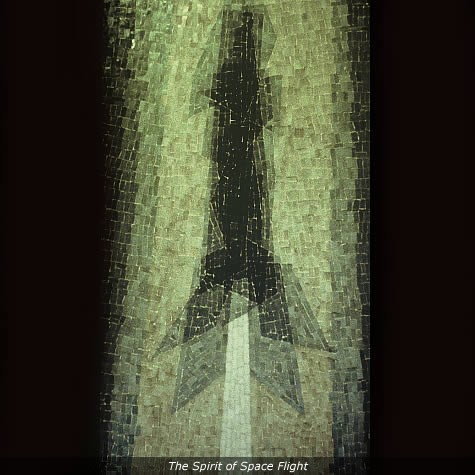 Spirit of Space Flight by Alan Bean shows a highly stylized pale green rocket lifting off with a grey and white background it is rendered in a tiled mosaic style.
“Some of the things you cannot do in painting that you can do in prose. If you want to talk about Fear –I would love to do a painting that shows the kind of latent fear, or the heightened awareness when you’re an astronaut in a space suit on the lunar surface. That, you know, if a little meteorite comes through your suit you’re dead, or if somebody didn’t do the sewing of the zipper right, or something like that, you could die. You don’t dwell on it, but you do have knowledge of that and so it gives you a heightened awareness, and so you can’t –I haven’t figured out a way to show it and I haven’t seen any other artist that can show it either. So, there’s certain things that you can’t show.”–Alan Bean for Red Blue Shift Magazine
Left-Brain: Aeronautical Engineer, Fighter Pilot, Test Pilot, and Astronaut
Alan Bean was born in in Wheeler, Texas, on March 15, 1932 to Arnold and Frances Bean. He had one sibling, a sister named Paula.
After graduating from Paschal High School in Fort Worth, Texas he went on, in 1955, to receive a Bachelor of Science degree in aeronautical engineering from the University of Texas. During his time at UT, he was a Navy ROTC Student, and upon completing college received his commission as a Navy officer and began fighter pilot training.
After a four-year tour of duty assigned to an attack squadron in Jacksonville, Florida, he completed test pilot training at the United States Naval Test Pilot School located at Patuxent River, Maryland. The alumni list of this program reads like a who’s who of astronauts involved in the early US space program and includes Alan Shepard and John Glenn among many others.
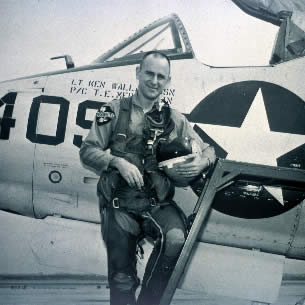 Alan Bean is standing in front of a Douglas A-4 Skyhawk wearing his pilot's jumpsuit.
In 1963, Bean was selected as a member of Astronaut Group 3 by NASA. In 1967, following the death of Astronaut Clifton Williams in an airplane crash, he was selected by Commander Charles “Pete” Conrad, Jr. (a former instructor of Bean’s in test pilot flight school) to replace Williams as Lunar Module Pilot on Apollo 12. He joined Richard F. Gordon, Jr. as Command Module Commander, completing the three-man crew.
After his visit to the Moon, Bean went on to become spacecraft commander of Skylab 3. After retiring from the Navy as a captain, he was head of the Astronaut Candidate Operations and Training Group. He resigned from NASA in 1983.
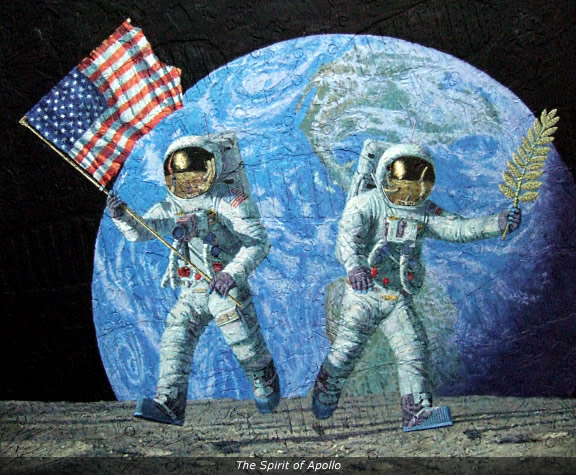 Alan Bean is standing in front of a Douglas A-4 Skyhawk wearing his pilot's jumpsuit.
Right-Brain: Artist and Painter
At the same time he was training to become a naval test pilot he began taking night school courses in watercolor and drawing at nearby St. Mary’s College.
He experimented with abstract art for a while, and then realism before settling on the impressionistic style he currently uses.
 An abstract painting composed of a black background and showing a rocket lifting off. An irregular grid pattern of yellows, oranges, and white representing the blast of the rocket's engines. The full moon is high in the sky.
RED BLUE SHIFT:
What do you hope future generations will get from your art? What do you see as your artistic legacy?
ALAN BEAN:
Well, what I’m hoping --I left the space program to tell the stories that I remember from this great adventure, one of the great human explorations of all time, not the greatest, maybe, but one of the greatest, and so, I’m hoping to just leave more information about it; more celebration of an amazing accomplishment, more understanding of what we we were able to accomplish. What ordinary humans are able to do accomplishing an impossible dream, if they’re willing to, you know, work together, sacrifice, and continue to move towards their goals. And I think there’s a huge lesson there. I know there is one in my own head all the time about this. About how we all were regular people that were dedicated, and we were able to accomplish these amazing things of driving on the moon in a rover, or walking around picking up rocks. Of course, in the future humans will do all of that, again on the Moon, and Mars, and other places in the Universe that will be –that you could, in fact, walk around, and then they will, hopefully, read the stories and look at the paintings and say, “You know we can do that better.” or, “Well, let’s do more of that.” or, “That’s a good thing to do.” or, “There they made a mistake let’s don’t make that mistake ourselves.” and that sort of thing. It’s just a matter of trying to be one of the giants that future generations [will look back on so that they can] build on [our experiences] as we built on the explorations and discoveries of previous generations.
Trans-lunar Injection
“..frequently if you’re hit by a good bolt of lightning, it’ll jar the airplane, and often you see the flash because it’ll get on the nose. Usually on an airplane it lands on the nose but trails off the wings or the tail usually, kind of goes through you…Then I’d hear Pete and Dick over there. They’re working on their part of the problem, and they start talking about lightning, and that doesn’t mean a lot to me, because I’m still trying to figure out what to do. Then they call to get me to throw a switch…So by the time we got into orbit, we were okay, but it wasn’t because I had done anything that I had learned in training. It turned out that if I’d just done what the ground said, we’d have gotten it faster. The only thing I really used was like a basic thing of being careful if things are going in the right direction. Things were, and we finally got the power on, and then we got up into orbit.”–Alan Bean for the NASA Johnson Space Center Oral History Project
.jpg) Lt. Cmdr. Alan Bean, in his official Nasa portrait, is on one knee in front of the Apollo space capsule and wearing his astronaut's suit.
Lt. Cmdr. Alan Bean, in his official Nasa portrait, is on one knee in front of the Apollo space capsule and wearing his astronaut's suit.
“The switch was fairly obscure, and neither Flight Director Gerald Griffin, CAPCOM Gerald Carr, nor Commander Conrad immediately recognized it. Lunar Module Pilot Alan Bean, flying in the right seat as the spacecraft systems engineer, remembered the SCE switch from a training incident a year earlier when the same failure had been simulated.”—Apollo 12 entry from wikipedia.com
Left-Brain: Process & Workflow
After deciding what subject to work on, Bean will use model mock-ups complete with directional lighting as aids. He also works with photographs taken during Project Apollo.
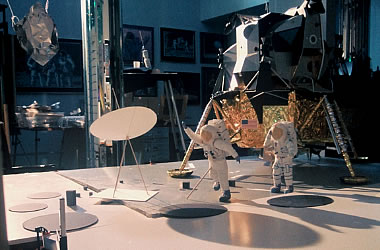 A mockup of two astronauts on the lunar surface standing in front of the lunar lander. One of them is throwing a piece of foil into the air.
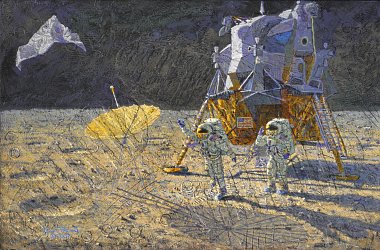 A painting of two astronauts on the lunar surface standing in front of the lunar lander. One of them is throwing a piece of foil into the air.
On occasion, he will take creative license and add astronauts into a piece that were never on the lunar surface. This is the case with his piece “The Fantasy” that portrays Gordon (orbiting the moon during Apollo 12) standing alongside Conrad and Bean on the surface of the Moon. Bean gives the following explanation on his website, “We often fantasized Dick joining us on the Moon for all the fun, but we could never really find a way. But now I’m an artist and in my paintings I can have it my way. Now, at last, our best friend has come the last 60 miles.”
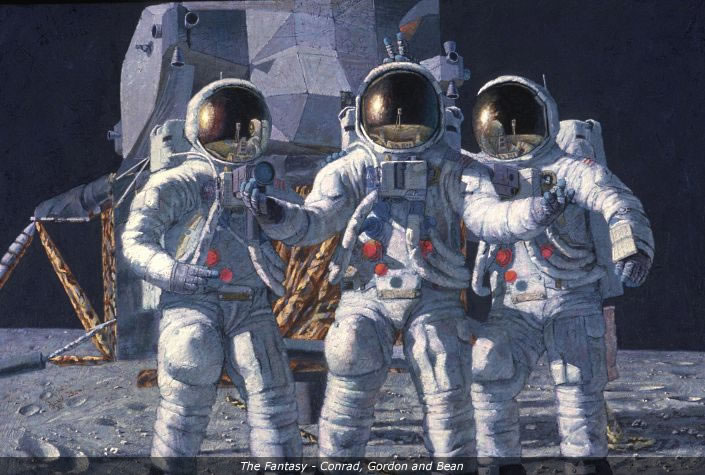 A painting showing three astronauts on the lunar surface with the lunar lander behind them.
There are also a few extremely rare tools and techniques he uses. So rare, in fact, they serve to make his paintings unique.
These tools and techniques, not readily apparent to the casual observer, serve as nods to his background as an aviator and astronaut. He uses aviation plywood instead of canvas with a textured application covering it. Upon this, he’ll make impressions with a bronzed spacesuit boot print, a geological core sample tube and rock hammer used during the mission.
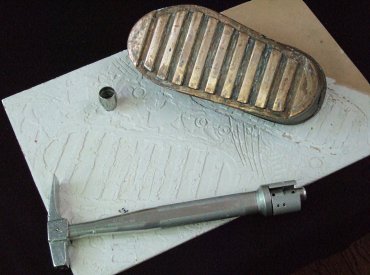 A bronzed spacesuit boot print, a geological core sample tube and rock hammer Bean used during his lunar mission.
The most precious part of all of this is the fact that he also includes moon dust in his artwork by cutting up his patches into very small bits and placing them into his paintings.
RED BLUE SHIFT:
And what’s the total number of pieces that you’ve completed?
ALAN BEAN:
Well of a space paintings…the ones I’ve completed to sell, I think it’s something like, maybe, 190 and really it takes me two months or more to do a painting and I’ve asked myself each time why is it going to take this long? I just did one that’s sort of like it, that it’s never –it would be like somebody that’s creating music, –you can’t’– the next piece of music isn’t going to be sort of like the last one, it’s going to be different; the words, the notes, the timing, everything is different, and even though you think it’s going to be the same, it never is. I don’t know the answer to some of these questions only that, that seems true. Another part of it is, I think I know artists, because I met a number and watched them paint, I think I know artists that can paint the same painting I’m doing as well or better and, maybe, doing it in a week or two weeks. So, it’s not like I’m very fast. It’s more like that’s what it seems to take meand then as I got better over the years, which I have, I didn’t speed up doing the same thing at that same skill level, my skill level now is better than it’s ever been, and maybe what I’ve got in my head, I’ve asked myself this, is sort of a “Let’s do the best we can in two months.” Hopefully, it will be better than others. Maybe not. But, you know, in general, if I look at my paintings now they’re more beautiful and a lot of other elements that make them that way then they have ever been.”
Right-Brain: Paintings & Prose
These are some of the paintings by Alan Bean. More can be viewed on his personal website (along with descriptive prose), and his gallery website. In our opinion, these accompanying stories are worth special mention. When they’re read, one is of reminded of Civil War letters or notes G.I.s sent home during World War II. One is left with the notion that, not only do people not write like this anymore, people don’t think like this anymore.
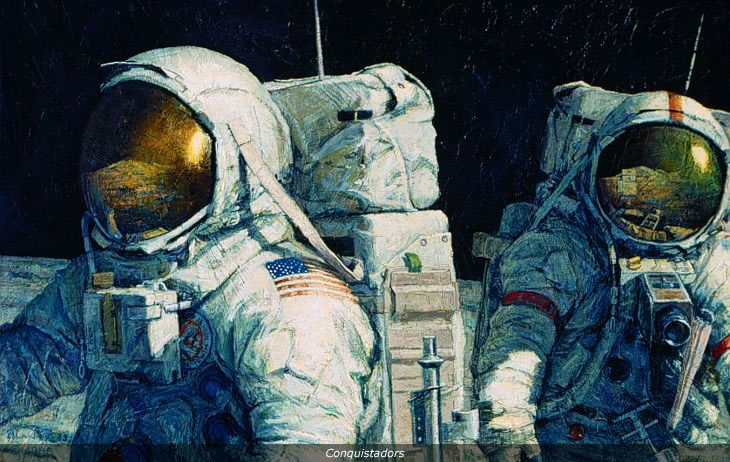 Bean's painting of two astronauts on the lunar surface.
“I have painted Apollo 15 astronaut Jim Irwin leading Dave Scott as they move about their work on the Moon. Dave observed: “As we advance, we are surrounded by stillness. No wind blows, no sound echoes. Only shadows move.” Dave continued: “I hear the reassuring purr of the miniaturized machines that supply vital oxygen and shield me from the blistering 250 degree Fahrenheit surface heat of lunar morning.” The spacesuit appears bizarre and unworldly; but it contains a life sustaining environment.
Explorers throughout history have probably looked strange and unreal to the natives of the new lands they visited. But we were different. There were no natives and, enclosed in our spacesuits, we looked like creatures from other planets to our own friends and families.” –Alan Bean’s description for “Conquistadors” from his personal website, alanbean.com
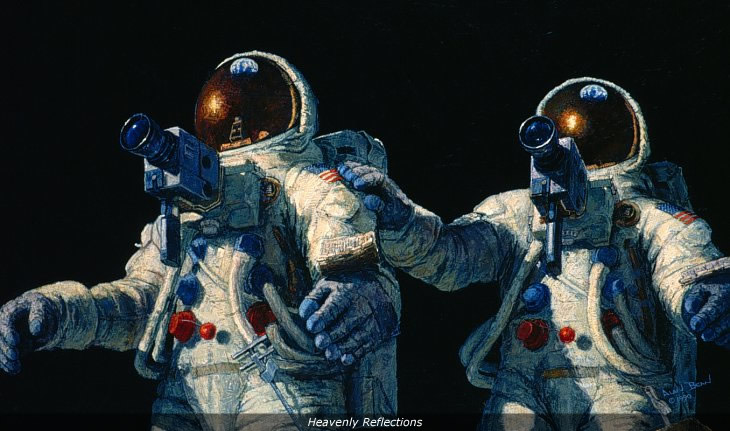 Two astronauts looking at the sunrise from the moon's surface. It reflects in their mirrored visors and one has his hand on the shoulder on the other one.
"I have painted Pete Conrad and myself 239,000 miles from Earth, standing on the Ocean of Storms, looking homeward. Pete and I had come a long way together. We had met some ten years before. I was a student in Navy test pilot school and Pete was one of my instructors. I admired him for his professional skills and for his relaxed, colorful attitude. He is the best astronaut I have ever known. It was incredible to be standing on the Moon with him. It was good to take a moment to reflect on all the dedicated people it took to get us here for America. We were the lucky ones. The stars were not visible because the sunlight reflecting from the bright lunar surface caused the irises of our eyes to contract, just as they do on Earth at night when standing on a brightly lit patio. As we looked up, the sky was a deep, shiny black. I guessed that deep, shiny black was the color one sees looking into infinity. As I touched Pete’s shoulder I thought, can all the people we know, all the people we love, who we’ve seen on TV, or read about in the newspapers, all be up there on that tiny blue and white marble? Earth is small but so lovely. It is easily the most beautiful object we could see from the Moon. It was a wondrous moment. If there is a God in heaven, this must be what he sees as he looks toward his children on the good Earth." –Alan Bean description for "Heavenly Reflections" from his personal website, AlanBean.com
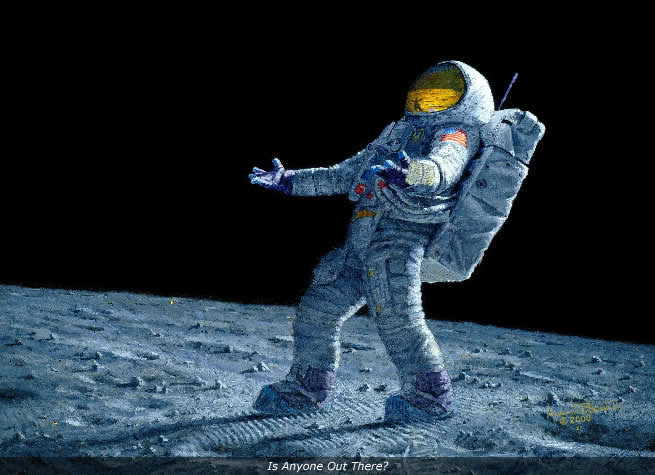 An astronaut looks into the heavens.
RED BLUE SHIFT:
I’d like to change a little bit from the technical aspect of your art and talk about the actual subject matter, in particular, you say that you’re more spiritual than religious and alot of your paintings reflect this. In particular, “Is Anyone Out There?” and “Conquistadors”, there’s a sense of humanity and duty in the face of awe –in the face of spiritual awe. Can you discuss the metaphysical aspect of, or any philosophical conclusions you’ve come to through your pieces?
ALAN BEAN:
In doing the mission, doing the flight plan, I put down times to set aside to just listen, or be aware or whatever, to think about that issue. When I was actually there, and actually between the Earth and the Moon, and the things like that, and see if there was anything that I felt and I did not. I did not get any insight.
The only insight I probably got was after home and watching other astronauts. No astronaut ever changed their belief from agnostic to Christian or Muslim or whatever else, or the atheists. Everybody stayed the same. If you went up there as a Christian and were very religious, then, in general, you came home with exactly the same, maybe, with a little more conviction. So, that was an interesting [thing] that made me believe that there’s no answer out there.
My belief now is any answer you’ve got is in your heart. If you were born in Saudi Arabia you would believe in Allah and you would be a Muslim and if you were an intense Christian here you would be an intense Muslim there because your parents sent you to Muslim kindy-garten [sic], or whatever it was, instead of Bible school, like my parents sent me, and so I think, I think the answers to questions like that are never outside yourself. They’re only in your own heart and depending on your heart, how strong you feel that way. My particular heart, I’m not a believer anymore. I was when I was a boy and I went to Sunday school and I taught Sunday school when I was a test pilot. But over the years, I gradually, through what I saw occurring on in the world –that drifted away. It drifted away mostly when I became a parent because one of the talks they give you is “God is our Father” and when I became a father, [derisive ‘huh!’] I treated my kids a lot better than God treats a lot of kids. God, if he’s up there, he treated me pretty good. But you don’t have to look very far to see if he’s our Father he’s doing a crappy job. So, it made me drift away from this God idea. Do you see? And it wasn’t –it’s just what’s in my heart.
So, there you go and that’s what I’ve observed and I think that astronauts do their duty. I think that many people do their duty in this world. A lot of mothers do their duty with great sacrifice. A lot of people don’t do their duty, a lot of people; many congressmen, presidents. They don’t do their duty. They do what helps them when they retire, or what will allow them to get an income and get re-elected. They don’t do their duty. So, I look around and I think of these guys over in Iraq and Afghanistan and other places and I look at them as patriots. I don’t generally look at congressmen as patriots at all. Used to when I was younger then I began to say, “You know these guys aren’t doing things right.” They aren’t. They’re busy trying to make their party strong and get re-elected they’re not busy trying to do the right thing for America. You don’t see them working on trying to solve the immigration policy. Do you? They’re going to postpone it. Indefinitely, in my opinion. But, anyway –there you go. It’s just an opinion.
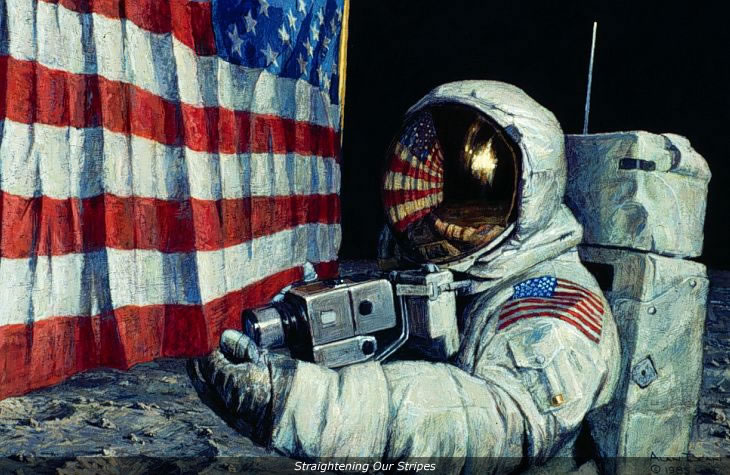 An astronaut straightens the American flag on the moon's surface.
Corpus Callosum
RED BLUE SHIFT:
Art can be a very lonely endeavor. In some of the stories you tell, you say that others were incredulous at your decision to become a painter and that others encouraged you.Who have been the people that have encouraged you and how has that been helpful?
ALAN BEAN:
Well, it’s been very helpful because when you do things that are creative you don’t know how they’ll be received. You hope that your efforts will be received well and it will add to the pleasure and knowledge of other people because it is a communication. If you were a poet and nobody read your words then you’ve kinda wasted your time. Same way with a musician that writes songs but nobody will listen to them. I’m not saying they should quit writing songs. But, it does keep their work from being useful in the flow of history.
I’m hoping that what I do –the stories, I tell– will help future generations, present generations, to look at some of the things they might do better, or not do that we did, or be inspired by what we did so that they go doing more. But, if they don’t, as I said earlier, my job is to do that. My job is to try to do what I dream is the right thing to do and quite a number of people agreed with this, apparently you do for example, and so, that’s good. I’d hate to be doing something if nobody agreed with me. And the way it worked with astronauts I noticed, when I announced I was going to do this, is a percentage of them thought it was a good idea and those were the people, in my opinion, that had some right-brain activity, you know, that they did. People that read a lot, you might say. People that were in hobbies, –hobbies were in some other profession, kind of. The medical doctors all liked it. See? Because they have to think both with their left and right brain. When you’re a pilot you think mostly with your left brain and so, many of those individuals, they told me –they said, “Alan, you’re wasting your knowledge. Do you think this is a worthy way to spend the next years of your life?” Because they couldn’t see paintings as worthy. If you went to their house they didn’t have beautiful paintings on the wall. It’s because they just didn’t see that as important. Heck, maybe it isn’t. It wasn’t for them. Do you see what I’m saying?
So, the people that did talk about it and thought it was a good idea or at least were on my side –I had a good friend [chuckles] Fred Haise. Great astronaut. The last day I was there he came in the office and I was kind of packing up and I knew he wanted to wish me well and tell me this was a good idea, but he couldn’t honestly do that and so he kept hanging around wanting to do it –his ethics wouldn’t allow him to say that. I’ve laughed about it many times because he’s such a good guy and a good friend and I see him from time to time. He’s changed his mind.
All the astronauts like it now. Because I am preserving an exploration that they were willing to die for essentially, and devoted a number of years of their life to, and so I’m showing that. They couldn’t think of it that way. All they could think about was the paintings they saw in the art galleries or something, that had nothing to do with them. This has everything [to do with them]. All the astronauts love it now, but at the time –Fred Haise, for example, [chuckles again] I’ve chuckled. He liked me a lot, we liked each other but he just couldn’t bring himself to lie and say, “I know this is a good idea, Alan.“ He never said it. He hung around a long time and we talked about things, but he never brought it up. So, there you go.
You can’t live your dream if you are going to let other people get in the way. You have got to find a way to hold on to your dream. None of my high school [classmates] wanted me to go in the military. They told me a lot of reasons it was a bad idea. When I got to college –and all my roommates there and people in the dorm– they all thought it was a bad idea . Maybe, one or two thought it was a good idea.
First time I was around people that thought being a pilot was a good idea was when I got to the first squadron. It was then. And then all those guys loved being a pilot. “Where have you been?” Then I realized that they had been going through the same situation.
You’ve got to hold onto your dream. You too! It’s hard to do because people don’t have the same dream. They like you, they kinda imagine it would be better if you –not selfishly, followed their dream but– did more things their way, you would be happier. Because, see if they did more things that way they would be more happy.
It’s tough.
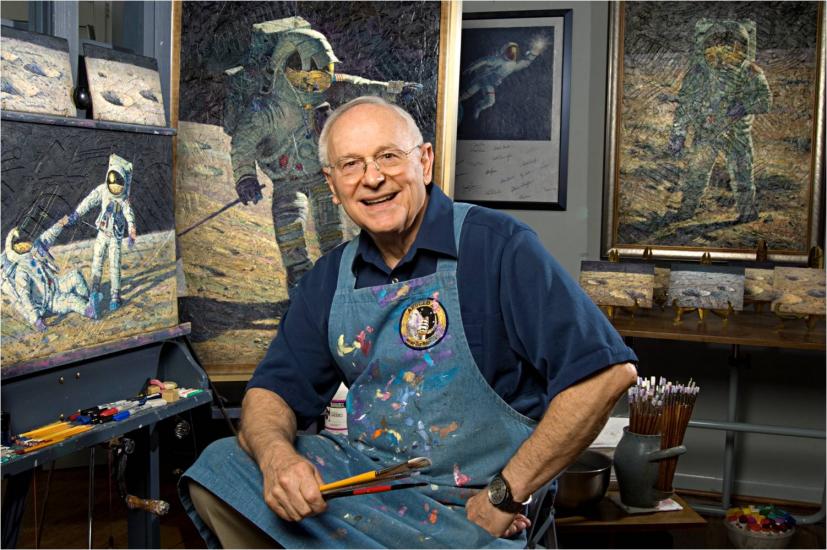 Alan Bean in his artist's workshop with his paintings.